
Holiday Scheduling: Balancing Coverage, Fairness, and Employee Choice
Few operational moments test trust between frontline teams, supervisors, and HR quite like the holiday season. Here are seven practical tips to navigate holiday scheduling with clarity, fairness, and respect.
Few operational moments test trust between frontline teams, supervisors, and Human Resources quite like the holiday season. While customer demand spikes, shipments tighten, or critical facilities require 24/7 coverage, employees are simultaneously trying to honor family traditions, travel plans, and much-needed rest.
When holiday scheduling is handled reactively or behind closed doors, resentment lingers well into the new year — leading to last-minute call-outs, perceived favoritism, and avoidable turnover. When frontline leaders and HR managers partner early with transparent rules and structured flexibility, you can safeguard operational coverage while giving employees real voice and predictability.
Here are seven practical tips frontline leaders and HR managers can implement to navigate holiday scheduling with clarity, fairness, and respect.
1. Publish Holiday Staffing Needs and Deadlines Early. Uncertainty fuels anxiety and informal lobbying. Waiting until a few weeks before a major holiday forces employees to put personal plans on hold and leaves supervisors scrambling to fill gaps.
For Frontline Leaders: Forecast exact headcount and skill-mix requirements by shift at least 6 to 8 weeks ahead so your team knows precisely how many spots are open for time off. For HR Managers: Establish a clear, company-wide holiday request calendar with firm submission deadlines and guaranteed response dates — and communicate it across every shift huddle and breakroom board.
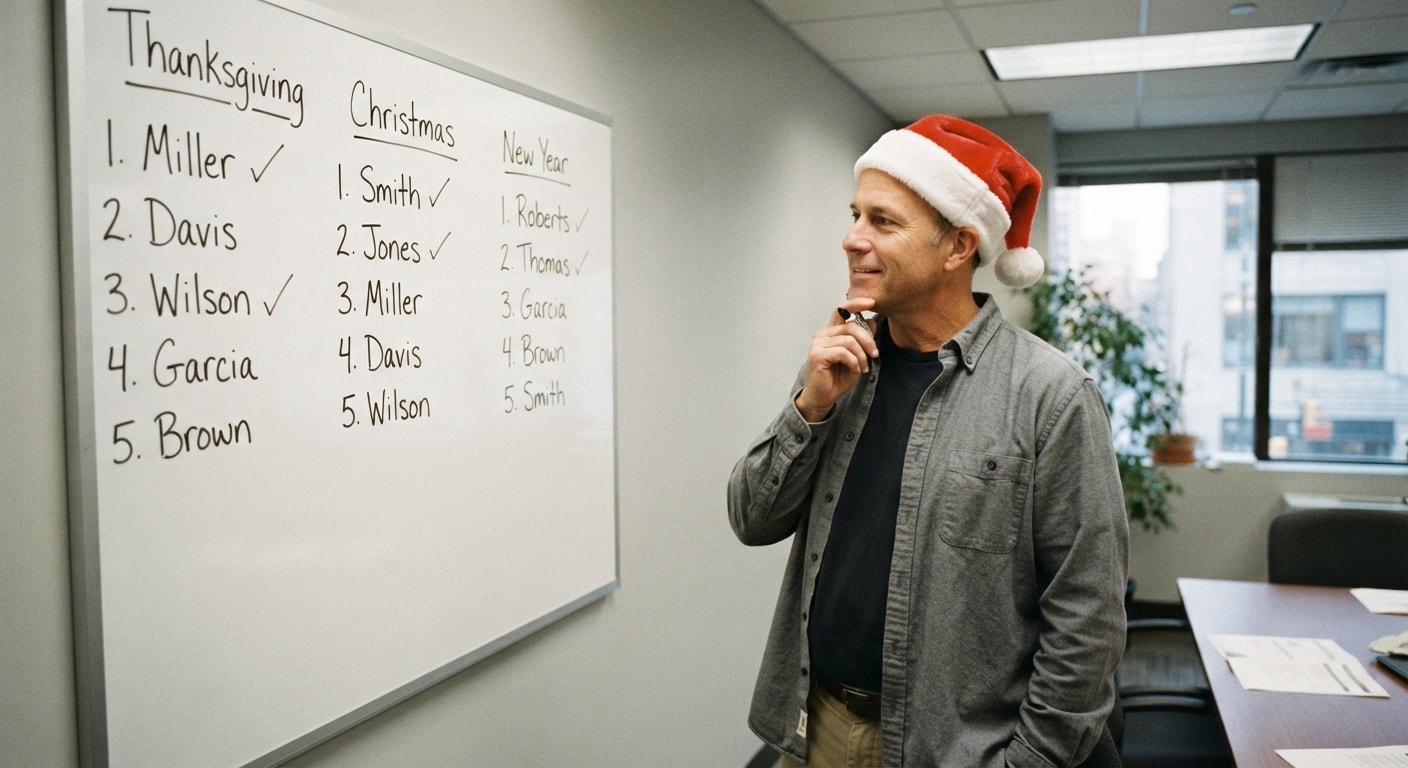
2. Replace First-Come, First-Served with Transparent Rotation Rules. Pure first-come, first-served systems often reward whoever happens to be near a computer or in the supervisor's office first, while pure seniority locks newer hires out of every holiday for years.
For Frontline Leaders: Track who worked major holidays over the past 12 to 24 months and apply the same transparent priority order across every crew and shift. For HR Managers: Standardize holiday rotation criteria — such as alternating major holidays year-over-year or blending seniority with prior holiday worked — so supervisors never have to invent tie-breakers on the fly.
3. Offer Ranked-Choice Bidding Instead of All-or-Nothing Requests. Most employees do not expect every single holiday off — they usually care deeply about one specific date, shift, or family window. Binary approved-or-denied systems miss easy wins.
For Frontline Leaders: Ask team members to rank their top two or three holiday preferences so you can match people to what matters most to them. For HR Managers: Configure scheduling forms or workforce tools to capture ranked preferences and partial-shift availability rather than rigid full-day blocks.
4. Build Pre-Approved Shift-Swap and Volunteer Pools. Even the best master schedule will encounter unexpected life events. When swaps require layers of red tape, frustrated employees are far more likely to call out sick.
For Frontline Leaders: Create a visible Holiday Swap and Pick-Up Board where qualified peers can trade shifts cleanly as long as core skill coverage and overtime thresholds remain intact. For HR Managers: Pre-authorize straightforward swap guidelines and cross-training qualifications ahead of peak season so supervisors can approve peer trades in minutes rather than days.
5. Pair Holiday Coverage with Meaningful Incentives and Recovery Time. Asking employees to miss family gatherings requires recognizing the real personal sacrifice involved. Relying solely on mandatory assignment erodes morale fast.
For Frontline Leaders: Protect adjacent days off for team members who work prime holiday shifts — avoid scheduling someone to close on Christmas Eve and open on December 26 unless they explicitly volunteer. For HR Managers: Design balanced holiday incentives such as premium holiday pay, floating personal holidays to use in Q1, meal provisions on shift, or guaranteed prime-pick priority for the next holiday cycle.
6. Communicate No Decisions Privately, Promptly, and Honestly. How a leader delivers a denied time-off request matters almost as much as the decision itself. Finding out via a posted spreadsheet or receiving a vague excuse destroys credibility.
For Frontline Leaders: Have a brief, respectful one-on-one conversation with anyone whose top choice could not be granted — explain the coverage math transparently and offer the next-best alternative immediately. For HR Managers: Equip supervisors with simple, empathetic talking points and ensure every denial is logged consistently so patterns can be reviewed for equity.
7. Run a 15-Minute Post-Holiday Debrief to Improve Next Year. Once peak season ends, most teams rush straight into January targets without capturing what worked and what broke down — repeating the exact same scheduling friction twelve months later.
For Frontline Leaders: Ask your crew two quick questions in a January huddle: What felt fair about how we handled holiday shifts? and What is one thing we should adjust next season? For HR Managers: Review holiday call-out rates, overtime spikes, and employee feedback alongside operations leaders in January, updating your scheduling playbook while lessons are still fresh.
You cannot give every employee every holiday off — but you can give every employee a clear timeline, a fair process, and genuine respect. When frontline leaders and HR managers align early on coverage, fairness, and employee choice, your operation stays strong through peak season and your team enters the new year energized rather than exhausted.
Subscribe to our blog to receive more practical tips and insights for frontline leaders and HR managers. Have a specific topic or workplace challenge you would like us to discuss? Reach out at HR-Lead.com or Info@hr-lead.com.